Open source

Open weights, local inference and community-run AI.

Illustration for the frontier model on a home PC story
open sourcemodels

A frontier-class DeepSeek model now runs on a home gaming PC, slowly

A post on r/LocalLLaMA from August 3, 2026 documents DeepSeek-V4-Flash-0731 running locally at Q3 quantization on an Intel Windows machine with 24GB of VRAM. Another user ran the full 284B mixture-of-experts checkpoint at 33 tokens per second on two used RTX 3090s plus a secondhand quad-Xeon server. Caveats: a Q3 quant is compressed and degrades knowledge unevenly, and the speeds are low.
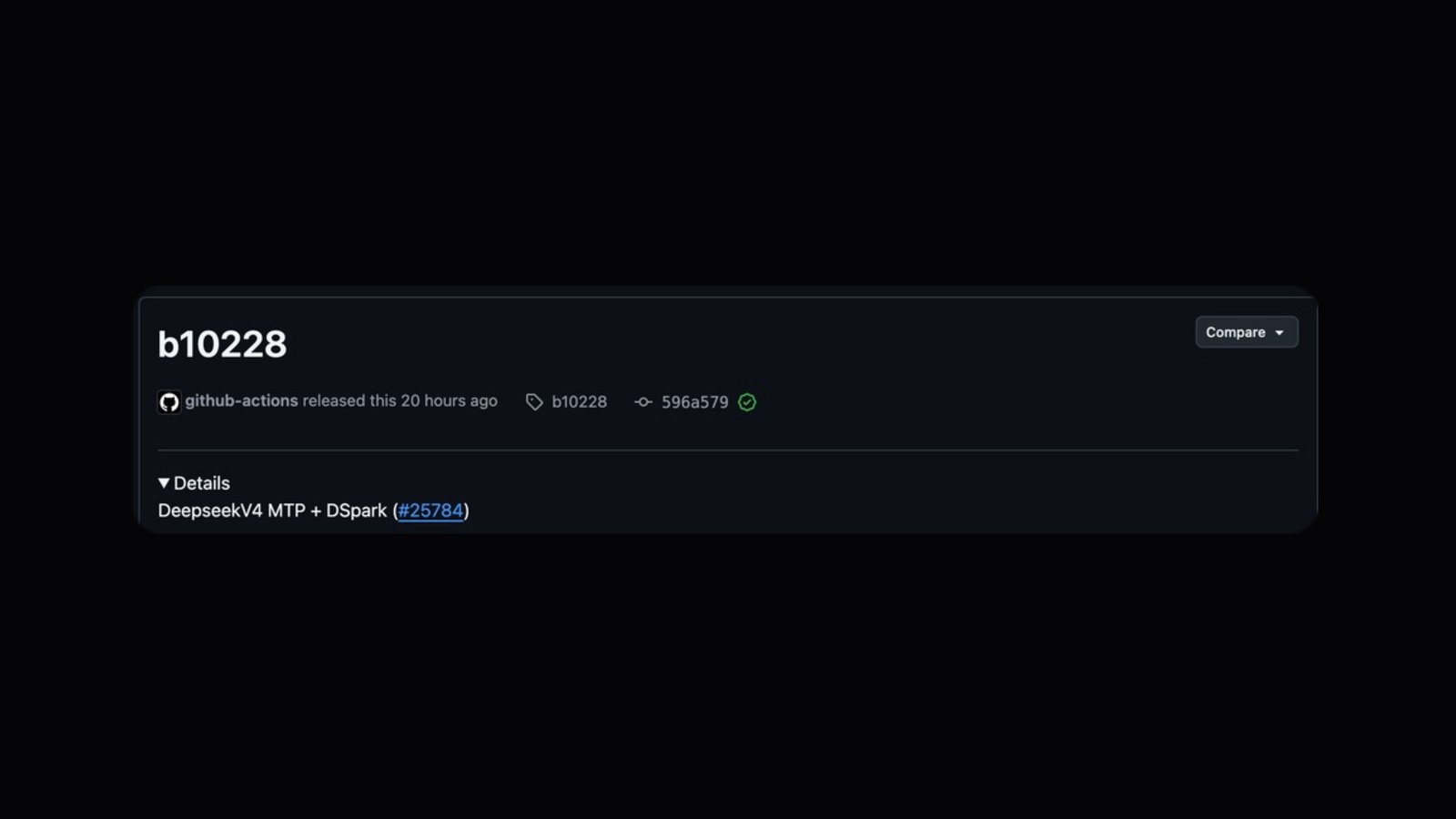

Illustration for the llama.cpp multi-token prediction release
modelsopen source

llama.cpp ships multi-token prediction for DeepSeek V4-Flash

llama.cpp release b10228 landed on August 2, 2026 with multi-token prediction for DeepSeek V4-Flash, letting the model draft several tokens per forward pass so local generation speeds up without new hardware. It arrived two days after DeepSeek released V4-Flash-0731, which pushed Terminal Bench 2.1 from 61.8 to 82.7 at unchanged prices.

Illustration for the optical file transfer story
open source

Phone-to-phone file transfer with no network, built overnight with animated QR codes

Decimen Optical Transfer, published on GitHub under the handle bashalarmistalt, moves files between two phones with no Wi-Fi, Bluetooth or network: one phone flashes animated QR codes, the other rebuilds the file from camera frames. Documented goodput is roughly 129 KB/s, using Luby transform fountain coding so dropped or blurred frames do not break the transfer. The developer built the working prototype in a single night with Claude Code.

Illustration for the MCP stateless rewrite story

MCP goes stateless in the biggest rewrite since the protocol launched

On July 28, 2026, the Agentic AI Foundation released the MCP 2026-07-28 specification, the largest revision of the Model Context Protocol since launch. MCP moves from a stateful, bidirectional protocol to a stateless request/response core so servers can run on serverless and edge infrastructure, with Apps and Tasks shipping under a new versioned extensions framework. MCP recently passed 400 million monthly SDK downloads, about 4x growth this year, and Anthropic says the new spec is coming to Claude.

Illustration for the SK Telecom A.X K2 story
modelsopen source

SK Telecom releases A.X K2, a 688B open-weight model built for sovereign AI

On July 29, 2026, SK Telecom unveiled A.X K2, a 688 billion parameter mixture-of-experts foundation model, and released the weights on Hugging Face. It gains +32.2 points on average over predecessor A.X K1 (519B) across 14 domestic and international benchmarks, and +83.9 points on long-context comprehension and agent evaluations. SK Telecom positions it as sovereign AI for Korea's critical sectors: manufacturing, defense and biotech.

Illustration for the Open Secure AI Alliance story
policyopen source

Nvidia forms Open Secure AI Alliance without OpenAI, Google or Anthropic

On July 27, 2026, Nvidia announced the Open Secure AI Alliance (OSAA), uniting nearly 40 companies including Microsoft, IBM, Adobe, Cisco, Cloudflare, CrowdStrike, SpaceX and Hugging Face around open-source tools for defending against AI-powered cyberattacks. Contributions include Microsoft's multi-agent vulnerability scanning framework, Hugging Face's Safetensors format, and IBM and Red Hat's signed patching system. The alliance formed days after the Hugging Face breach, and OpenAI, Google and Anthropic are notably absent.

Illustration for the Kimi K3 weights release story
modelsopen source

Moonshot AI publishes Kimi K3 weights, the largest open release in AI history

On July 27, 2026, Moonshot AI published the full weights of Kimi K3 on Hugging Face, the biggest open-weight release in AI history. The mixture-of-experts model has 2.8 trillion parameters, a 1 million token context window, and weighs about 1.4 TB in 4-bit MXFP4 (roughly 5.6 TB at 16-bit). Running it takes a multi-GPU cluster of 80 GB cards, and the license terms were not published ahead of the release.

Illustration for the open weights letter story
policyopen source

Nvidia, Microsoft and 50 others urge Washington not to restrict open-weight AI

On July 24, 2026, twenty-five companies and organizations including Nvidia, Microsoft, Meta, IBM, Hugging Face, Mistral and the Linux Foundation published an open letter titled 'Open Weights and American AI Leadership,' asking Washington not to impose broad restrictions on open-weight models while it weighs a ban on Chinese ones. Within a day the list roughly doubled to around 50 names, with OpenAI and Google signing after the fact and Elon Musk endorsing it. Anthropic and Amazon are still not on the letter.

Illustration for the Kimi K3 sold out story
modelsopen source

Moonshot AI halts Kimi K3 sign-ups after demand maxes out its GPUs

Beijing startup Moonshot AI paused all new Kimi K3 sign-ups on July 19, 2026, 48 hours after launch, after demand pushed its GPU clusters to full capacity; existing subscribers keep access. K3 is a 2.8 trillion parameter mixture-of-experts model that has beaten GPT-5.6 Sol and Claude Fable 5 on several benchmarks, though users note it runs slower than top US models. Moonshot says it will release the model weights on July 27, making K3 the largest open-weight frontier model in the world.

Illustration for the Inkling release story
modelsopen source

Mira Murati's Thinking Machines Lab ships Inkling, an open-weights MoE model

On July 15, 2026, Thinking Machines Lab, the startup founded by former OpenAI CTO Mira Murati, released Inkling, an open-weights Mixture-of-Experts model with 975 billion total parameters (41 billion active), a context window of up to 1 million tokens, and pretraining on 45 trillion tokens of text, images, audio and video. The lab openly admits Inkling is not the strongest model on the market: its bet is that customizable AI will beat one-size-fits-all chatbots. A lighter Inkling-Small with 12 billion active parameters is coming as a preview.

Illustration for the Chinese AI traffic share story
modelsopen source

Chinese AI models now carry up to 46 percent of US enterprise AI traffic

On July 7, 2026, CNBC reported that the share of tokens used by US companies on Chinese AI models via OpenRouter has stayed above 30 percent every week since February 8, 2026, rising as high as 46 percent. The average across the previous 12 months was just 11 percent, and only 4.5 percent in the first half of 2025. Open-weight Chinese models like DeepSeek and GLM run 60 to 90 percent cheaper than top OpenAI and Anthropic models.

Illustration for the GLM-5.2 growth story
modelsopen source

GLM-5.2 becomes the fastest growing AI model of 2026 on a free MIT license

GLM-5.2, released by Chinese lab Z.ai on June 16, 2026 under a free MIT license, saw the fastest adoption of any model tracked by Vercel this year: daily token volume grew about 27x and customer count about 80x in its first full week. On SWE-bench Pro, a benchmark of real software engineering tasks, it scores 62.1 percent, ahead of GPT-5.5 at 58.6 percent, while costing a fraction of flagship US models.