Two six-foot humanoid robots scored a double knockout at REK2 in San Francisco
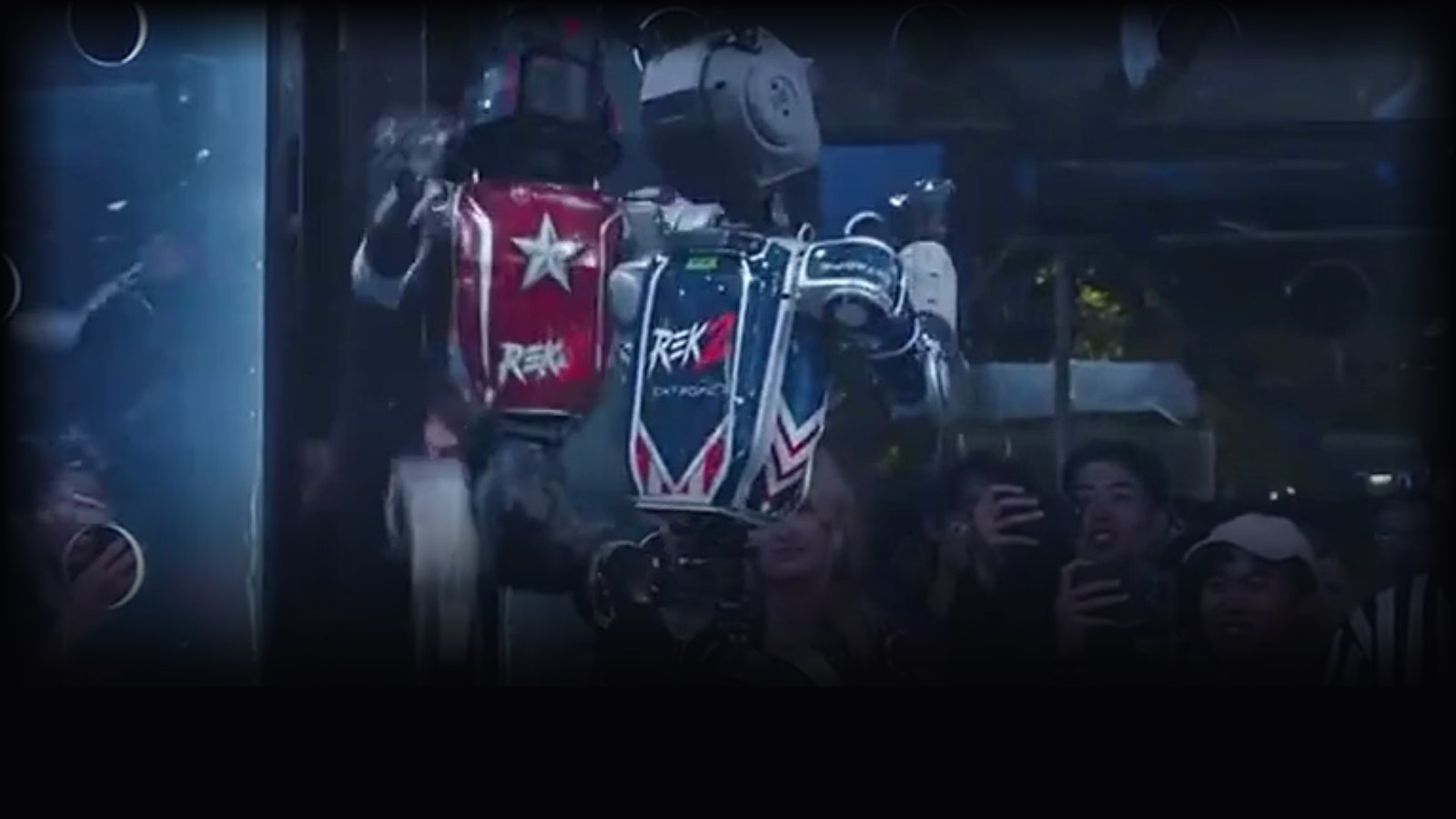
Two six-foot humanoid robots knocked each other out at the same moment, in front of a crowd in San Francisco.
What happened at REK2
REK2 ran on the evening of August 15, 2026 at REK’s San Francisco headquarters, billed by REK as the first six-foot humanoid robot fight in US history. The company streamed the whole card live on X.
The machines were EngineAI T800 humanoids, roughly 1.73 meters tall and 75 kilograms. They are not autonomous. Each robot is teleoperated in real time by a human pilot in a VR rig, so what the crowd watched was a person’s reflexes running through a robot body, with all the latency and balance problems that implies.
In the final, both robots went down in the same exchange. One stood back up, and the Japanese pilot listed on the scoreboard as Osone took the title, his second REK win in a row, according to Japanese outlet Denfaminicogamer. REK itself posted the moment with two words: “INSANE DOUBLE KNOCKOUT.”
Why a robot fight is a useful test
The spectacle is the point for the audience, but the engineering value sits underneath it. Full-contact fighting is one of the hardest tests you can hand a humanoid: the machine has to take an impact, lose its balance, hit the floor and get up again, repeatedly, under time pressure. That is the same category of physical AI problem that warehouse and factory robots keep failing at in quieter ways. A fall in a fulfillment center is a support ticket; a fall in a ring is a data point recorded in front of a live audience.
A double knockout, where both machines fail and only one recovers, is arguably the most informative outcome the event could have produced. The recovery, not the punch, is the capability being demonstrated.
Where the hardware comes from
There is a policy footnote. EngineAI is based in Shenzhen, and on July 29 the FCC banned new imports of foreign-made humanoid robots on national-security grounds. The T800s that fought in San Francisco were already inside the country, and under the ban, machines already in the US are the ones that get to compete.
That gives events like REK an odd role. Entertainment is how a technology gets its stress tests paid for, and for now the stress tests in the US are being run on hardware that can no longer be newly imported. Whether the format can grow on the existing fleet, and which manufacturers supply the next card, is the question to watch.
Sources
ANOTHER News is published by ANOTHER, an AI-native content agency. Daily coverage also runs on Instagram.
Related

3M's paid expert asked ChatGPT to show the company was 0% at fault, and the jury read the prompts
In the lawsuit over the January 2020 Watson Grinding explosion in Houston, which killed three people and damaged or destroyed hundreds of homes, plaintiffs' attorney Will Moye found a five-page "Citation Overlay" in 3M's defense materials and forced production of about 350 pages of ChatGPT prompts written by expert witness Josh Autenrieth of engineering firm KnightHawk, which 3M paid roughly $90,000. Prompts included "create an exceptional expert witness report defending the standard of care at 3M" and "show how 3M is 0% at fault for the explosion at Watson Grinding." Trial testimony put the finished report at 85 to 90 percent chatbot output; Autenrieth, billing $475 an hour, said the AI drafted "a straw man to build off of." On August 11 the Harris County jury awarded $61.5 million and assigned 30 percent of fault to 3M and 70 percent to Watson Grinding. 404 Media first reported the story from the court record.

Anti-AI art platform Cara was scraped in full for under ten dollars
On August 14, 2026 a Reddit user posted "I scraped all of Cara, an anti-AI art platform! Was a fun project," before the post was deleted and the account banned from the subreddit. PetaPixel put the haul at just over 12 terabytes at a cost of under ten dollars; AsiaOne reported roughly 12 million images belonging to more than a million users. Cara, built in 2023 by photographer Jingna Zhang as a portfolio platform for artists leaving larger networks over AI training, ran anti-bot and anti-scraping measures, a robots.txt telling crawlers not to take work for AI, automatic NoAI tags on uploads and an opt-out from federated services. Zhang responded on X: "A door not being bank vault-strong isn't an invitation to violate."
A sponsored Google result for OpenAI Codex led a developer to a Mac infostealer
A developer described on r/OpenAI on August 17, 2026 how they searched Google for OpenAI Codex, ran the install command from the first result, and then spent the day working out what had been copied off their Mac. The top result was a sponsored ad that appeared to point at a Google URL and led to a fake installation page hosted on Google Pages; its command echoed a legitimate-looking npm line and an openai.com address, then used curl to fetch a base64-encoded URL and pipe the response into zsh. The payload host had nothing to do with OpenAI. No persistence was found, which is consistent with a one-shot infostealer. Kaspersky flagged the same pattern in March 2026, and Straiker has tracked 88 domains across at least ten hosting platforms, 32 still live in mid-May, impersonating Claude Code, JetBrains and NotebookLM among others.